Understanding Cellular Defence Against Viruses
The Fletcher Lab is a research team at the MRC-University of Glasgow Centre for Virus Research (CVR). We investigate how cells respond to viral infections. Primarily, we are developing new ways of measuring this response, and characterising some of the proteins that provide antiviral defence inside the cell.
Latest News
-
Alice Wicks joins the team
We’re thrilled to be joined by Alice, who has been working in Danny Huang’s lab at the CRUK Scotland Institute, first for her PhD then a short postdoc. Alice will be exploring the manipulation of novel E3 ligases for targeted protein degradation, a topic she is very familiar with!
-
Early Career Microbiologist of the Year
We’re delighted for Emma who was awarded first prize in this year’s Microbiology Society award ceremony in London! Emma delivered her talk on the antiviral duality of OAS2.

-
Harry Scott joins the team
We’re very lucky to welcome Harry who joins us from Sheila Graham’s lab. Harry will be using microscopy and mass spectrometry to monitor targets of RNF213 ubiquitin ligases activity.
-
Summer 2025
This year we have the pleasure of hosting Allison Ward and Alegna Calderon Nunez for summer research projects. Allison is studying Molecular and Cellular Biology at the University of Glasgow and secured an Wellcome Trust Vacation Scholarship award to fund this project, while Alegna is on the University of Glasgow’s Infection Biology MSc programme. We wish Allison and Alegna all the success with their projects.
-
RNF213 activation paper published in Nature Communications!
Our paper describing the metabolic regulation of giant E3 ubiquitin ligase RNF213 by the well-known energy currency ATP, is out now in Nature Communications. Here we used an activity-based probe of cysteine E3 activity, with Cryo-EM and protein biochemistry, to dissect the basic requirements of RNF213 E3 activation by the small molecule ATP. By developing a method to deliver activity-based probes into live cells, we find that RNF213 activity is sensitive to intracellular ATP concentration changes that occur following interferon stimulation. This suggests that the antiviral state installed by interferons (typically defined by the profile of ‘interferon-stimulated genes’ upregulated by interferon) is also likely to be defined by protein activity changes that occur independently of protein abundance change.
-
Emma’s OAS2 paper is on BioRxiv!
Today we uploaded Emma’s story on the gene OAS2 to BioRxiv and you can find it here:
https://doi.org/10.1101/2025.02.24.639105
Here’s a brief summary.
To recognise viruses that have infiltrated our cells, the cell makes various proteins that are positioned as sentries in specific locations around the cell interior. Often at well-trodden entry sites used by viruses to get inside the cell, or at places inside the cell where viruses like to replicate. One of these proteins is called OAS2 and the gene that encodes this defender produces two ‘versions’ of the protein. These two versions (technically known as ‘isoforms’) only differ in a teeny portion at the very end of the protein that we call the ‘tail’. Why does this gene do this? Emma discovered that these two isoforms of OAS2 recognise different kinds of virus. The tools that each OAS2 isoform uses to inhibit their respective viral quarry are also distinct, perhaps reflecting the nature of each target virus. Overall, the discovery provides a great example of how our genes can individually contribute to a broad antiviral armoury, likely to provide defence against a multitude of diverse, unpredictable and constantly evolving viral pathogens.
-
EMBO | EMBL Symposium ‘Innate immunity in host-pathogen interactions’
5 members of the Fletcher Lab flew or trained their way to Heidelberg last week for the Innate Immune meeting at the EMBL. Eilidh, Emma, Hollie and Arda presented posters, and Arda was awarded an EMBO poster prize for his poster, entitled ‘ATP is a correlate of infection sensed by broad antimicrobial RNF213’ – well done Arda!
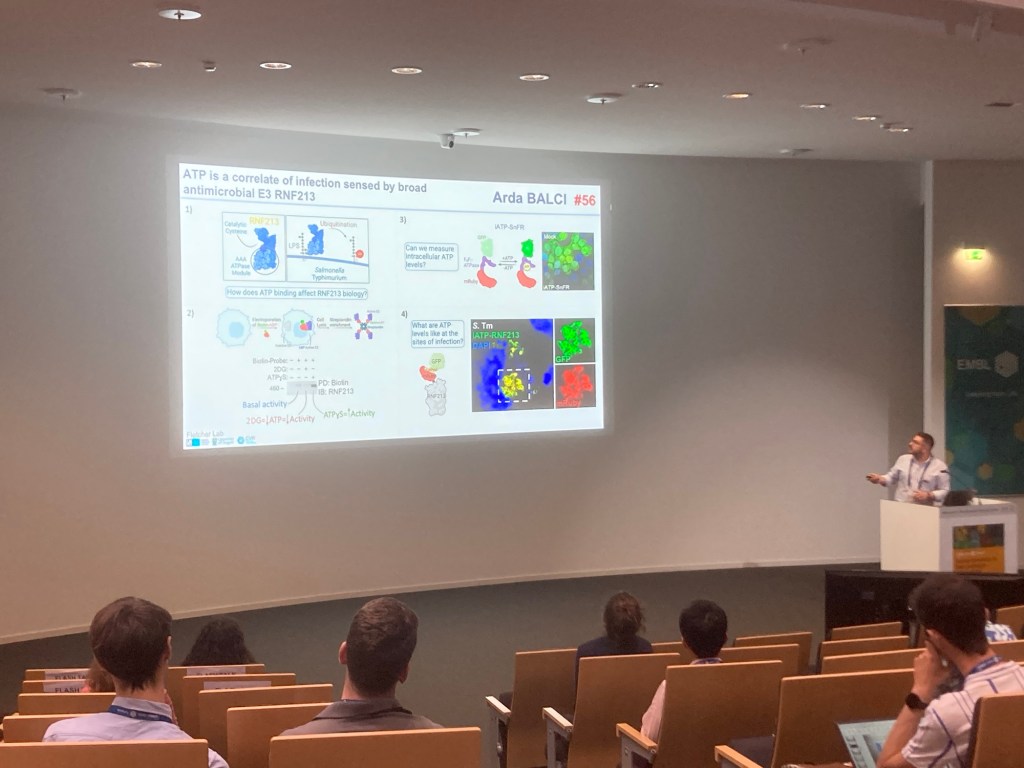
Arda introducing his poster at the EMBL -
Eilidh’s poster prize
Eilidh presented a poster on her work on antiviral enzyme ZNFX1, at the School of Infection and Immunity’s annual postgraduate poster competition. The event includes students from across the School, comprising virologists, parasitologists and bacteriologists. A judging panel awarded Eilidh’s poster 3rd place – well done Eilidh!
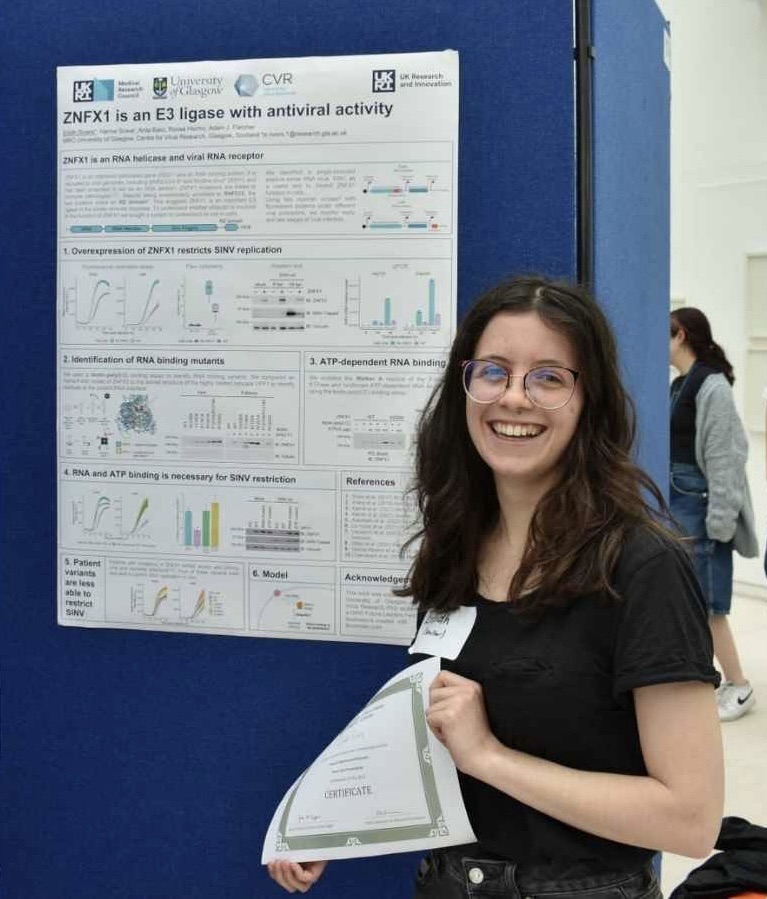
-
New starter!
We’re delighted to welcome Aidan Tollervey to the lab for the practical element of his MSc in Infection Biology. Aidan will undertake a 3 month research project, supervised by Eilidh and Emma, exploring how coronaviruses intersect with RNA binding E3 ligases.
-
Ubiquitin and Friends, Vienna
Eilidh, Arda and Adam attended the famous Ub&Friends meeting last week, organised by the Austrian SFB Targeted Protein Degradation consortium. We spent a few days with our friends in the Clausen lab (see Collaborators) and discussing exciting science with the ubiquitin community. Adam gave a short talk describing our new method for identifying E3 activity changes within living cells (a method begun in – and now a collaboration with – the Virdee Lab). Arda presented a poster on measuring ATP levels inside cells, and Eilidh presented preliminary data on her identifying a viral target of the unusual enzyme ZNFX1. We’re already looking forward to the 2025 meeting!
For more about this meeting, see the TPD website here.
 The Fletcher Lab